Chester County public records give residents and researchers a clear way to review government-held files through official county sources. These records include legal, property, and civic documents stored in structured public databases and verified data archives. They support document access for everyday needs such as verifying ownership, reviewing filings, or checking official registrations. Through organized record retrieval systems, the county maintains reliable storage that supports transparency in government. Chester County public records continue to serve as a trusted reference point for accurate information across many administrative departments.
Chester County public records cover many document types managed by courts, land offices, and registries throughout the county. Users often locate materials through searchable platforms that simplify document access and filter results by name, date, or case details. These public database tools connect people with archived data used for legal, historical, or civic research. Record retrieval may happen online or through office requests based on file category. By maintaining updated data archives, Chester County public records promote accountability and preserve verified documentation for public review.
What Are Chester County Public Records?
Chester County public records refer to government-held files that the public can view or request under state transparency rules. They include many types of official data stored by local agencies and shared through public database information systems. Public records describe documents created or maintained by Chester County Offices during daily operations. These materials form part of public data archives and help residents review actions taken by government departments. State laws, including Pennsylvania Right-to-Know standards, support official records access and promote open communication between agencies and the public.
Public records cover a wide range of government documents produced during routine duties. Agencies record, store, and organize these files for reference and accountability. Each department manages its own public database information system, keeping files current and searchable.
Typical record categories include:
- Court case files and docket listings
- Property and land records
- Vital records references such as birth or marriage listings
- Meeting minutes and ordinances
- Tax, licensing, or permit data
Transparency Laws and Public Access Principles
Pennsylvania transparency rules encourage open records practices across county agencies. Officials maintain public data archives and share non-restricted files through requests or digital tools. Sensitive materials, such as sealed court items or personal identifiers, remain restricted for privacy.
Key public principles include:
- Openness — Agencies provide viewable files where law allows.
- Accountability — Public database information reflects official activity.
- Fair Availability — Requests follow consistent review procedures.
The table below highlights how transparency affects record availability:
| Principle | What It Means for Public Records |
|---|---|
| Open review | Eligible files remain visible to the public |
| Data protection | Private details stay restricted |
| Equal treatment | Requests follow standard procedures |
Steps to Using a Record Search Portal
A record search portal allows users to locate Chester County public records through an organized public database search system. The Recorder of Deeds portal provides access to deeds, subdivision plans, recorded documents, and historical property records. This structured document lookup system requires users to enter through a login screen first, then proceed to the actual search interface.
Visit the Official Portal (Login Page First)
Start by opening the official Recorder of Deeds portal:
URL: https://chesterpa.countygovernmentrecords.com/ChesterRecorder/web/login.jsp
When the page opens, you will not see the search form immediately. Instead, you will see a Login screen with two options:
- Public Login – For unofficial copies
- Registered Users Login – For official/certified copies
If performing a general public database search, click “Public Login.”
After Login: Document Search Screen Appears
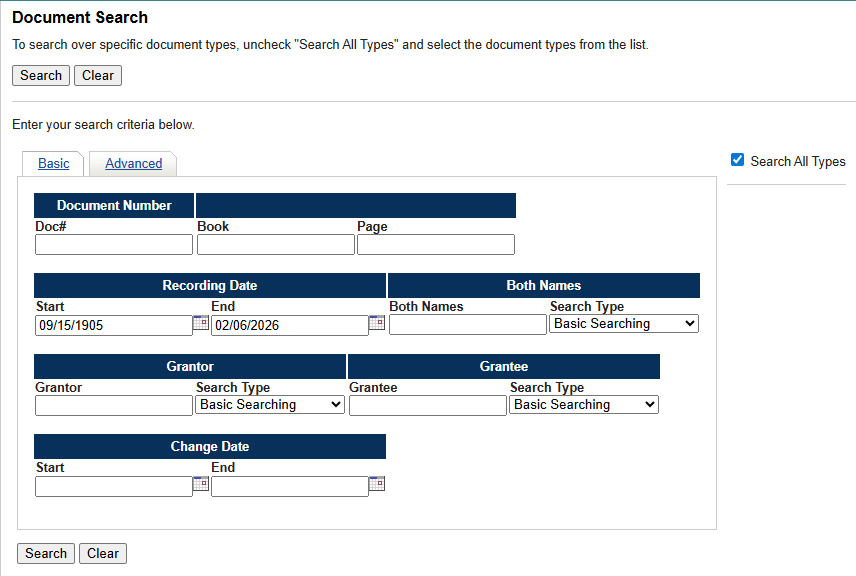
Once you click Public Login, the system loads the Document Search interface.
This page includes:
- Basic and Advanced search tabs
- Document Number fields (Doc#, Book, Page)
- Recording Date range
- Both Names search field
- Grantor and Grantee fields
- Change Date filters
- Search and Clear buttons
Enter Search Criteria
Users can search using different methods depending on available information.
You may enter:
- Document Number (if known)
- Recording Date range
- Grantor (seller name)
- Grantee (buyer name)
- Both Names field
For best results:
- Enter only one name field at a time
- Narrow the recording date range
- Leave unused fields blank
Run and Refine the Search
Click the Search button after entering details.
The portal displays results in a sortable table. Users can refine results by:
- Adjusting the date range
- Changing name fields
- Switching to Advanced search if needed
Download or Request Copies
From the results page, users may:
- View document images
- Download unofficial copies
- Request official certified copies (registered login required)
Types of Public Records Available in Chester County
A public records lookup Chester County search provides access to official government files maintained by county agencies. These records include legal documents, ownership records, archived reports, and public filings created during court, property, and administrative processes. Chester County maintains structured databases so residents, businesses, and researchers can locate accurate information efficiently. The categories below outline the most commonly requested record types.
Court Records
Court records document cases handled by Chester County courts. These legal documents reflect civil disputes, criminal proceedings, probate matters, and family court filings. Public access depends on record type and case status.
Common court records include:
- Civil case filings
- Divorce decrees
- Probate case files
- Judgments and court orders
- Docket entries
Property & Land Records
Property and land records confirm real estate ownership and transaction history. The Recorder of Deeds maintains these ownership records as part of the county’s permanent archive system. These documents establish legal rights related to property transfers and land use.
Available property records include:
- Deeds
- Mortgages
- Liens
- Subdivision plans
- Easements
Vital Records
Vital records document significant life events officially recorded by authorized agencies. These records are used for identity verification, legal proof, and government processing.
Vital records include:
- Birth certificates
- Marriage licenses
- Death certificates
Criminal Records
Criminal records document charges, court actions, and sentencing outcomes related to alleged offenses. These archived reports reflect official case activity recorded in the court system.
Criminal record files may include:
- Arrest reports
- Case docket information
- Sentencing details
- Court dispositions
Business & Licensing Records
Business and licensing records track registered companies and permitted operations within Chester County. These public filings confirm compliance with local regulations and state registration requirements.
Business-related records include:
- Fictitious name registrations
- Professional licenses
- Permit approvals
- Tax registrations
How to Access Government Records in Pennsylvania
To access government records PA, individuals must follow state transparency laws that regulate how agencies release official information. Pennsylvania’s Right-to-Know Law defines public access rights and outlines how information requests must be submitted and processed. The law applies to state agencies, counties, municipalities, and many public authorities. It promotes accountability by requiring agencies to maintain records in an organized format and respond within fixed deadlines. Anyone seeking public records must follow the formal request process established under state disclosure rules.
State Transparency Laws
Pennsylvania operates under the Right-to-Know Law (RTKL), which governs how public records are requested and reviewed. This statute requires agencies to provide non-exempt records and to justify any denial in writing. The law strengthens public oversight by setting clear timelines and procedural standards. Agencies cannot ignore a valid request, and each must appoint an Open Records Officer to manage submissions.
Key elements of the law include:
- Written response required within five business days
- Extensions allowed under specific conditions
- Written explanation required for any denial
- Appeal rights through the Office of Open Records
Right-to-Know Request Process
To access government records PA, a requester must submit a written information request to the appropriate agency. Requests may be filed online, by mail, email, or in person, depending on agency policy. The description of the record must be specific enough for agency staff to identify it. Broad or unclear requests may delay processing.
A proper request should include:
- Clear description of the requested records
- Relevant dates or subject matter
- Requester contact information
Who Can Access Records
Public access rights under Pennsylvania law apply broadly. Any person may request records, regardless of residency. The law does not require the requester to explain the purpose of the request. Businesses, researchers, journalists, and private citizens all have equal standing under state disclosure rules.
Restrictions and Exemptions
Certain records remain restricted under statutory exemptions. Agencies must balance transparency with confidentiality and public safety obligations. If an exemption applies, the agency must cite the legal basis for withholding the material.
Common restricted categories include:
- Social Security numbers and personal identifiers
- Active criminal investigation files
- Sealed or expunged court records
- Security or infrastructure-sensitive documents
Online vs Offline Record Retrieval Methods
Record retrieval in Chester County can take place either through digital systems or traditional in-person channels. Each method supports different types of document requests and offers varying processing timelines. Some records are immediately available through online archive access, while others require certified handling at a physical office. Choosing the right method depends on urgency, record type, and whether official certification is required.
Online Record Retrieval
Online record retrieval allows users to search government databases through an electronic search interface. This method works best for property records, recorded documents, and certain archived reports that have been digitized. Users can perform a public search, review summaries, and download available images without visiting an office. Processing timelines are usually shorter since results appear instantly.
Online retrieval features include:
- 24/7 archive access
- Instant public database search results
- Downloadable unofficial copies
- Digital payment for certified copies (when available)
Offline Record Retrieval
Offline record retrieval requires direct contact with the appropriate county office. This option is necessary when requesting certified copies, restricted files, or older documents not available online. Office visits allow staff assistance for complex searches, while mail-based document requests support remote submissions. Processing timelines may vary depending on request volume and record age.
Offline retrieval methods include:
- In-person office visits
- Mailed document requests
- Payment for certified copies
- Identity verification for restricted records
Public Databases and Data Archives
A public database stores government records in organized digital systems that support structured record storage and retrieval. These systems allow agencies to manage large volumes of information while supporting public review through searchable interfaces. Public databases and data archives work together to preserve official records. Active records remain easily searchable, while older files move into long-term storage systems. This structure helps maintain accuracy, consistency, and historical continuity across government departments.
How Records Are Stored
Government agencies store records using secure digital record storage systems. Each document receives a unique reference number and classification based on type, department, and date. This approach supports efficient tracking and long-term preservation. Some records originate in paper form and later convert into digital images.
Stored records may include:
- Legal filings
- Property documents
- Public filings
- Archived reports
Search Indexing and Retrieval
Search indexing allows users to locate indexed documents quickly within a public database. Indexes link document details such as names, dates, and reference numbers to court dockets search results. This process powers retrieval systems by narrowing results based on user input.
Indexed search fields often include:
- Names or entities
- Document numbers
- Filing dates
- Record categories
Archive Limitations
Data archives contain extensive historical records, yet limitations exist. Some older files may lack full indexing or digital images due to age or format. Access restrictions may apply to records containing sensitive information.
Common archive limitations include:
- Partial digitization
- Restricted personal data
- Processing delays for older files
Privacy, Legal Limits, and Transparency Rules
Transparency laws promote open government, yet they operate alongside strict privacy protection standards. Public agencies must balance public disclosure rights with legal limitations that restrict sensitive information from general release. Government records remain available for public review unless specific record restrictions apply. Courts and agencies follow statutory rules that define what may be disclosed and what must remain confidential. This balance supports accountability without exposing protected personal data.
Sealed Records
Some records become sealed by court order or statutory requirement. Once sealed, the file is removed from standard public disclosure systems and cannot be viewed through regular search portals. Only authorized parties, such as judges or involved attorneys, may access sealed materials.
Common examples of sealed records include:
- Juvenile court cases
- Adoption proceedings
- Expunged criminal files
- Certain family law matters
Confidential Information
Many public documents contain sections that require privacy protection. Agencies may redact specific details before releasing a record to comply with legal limitations. Redaction prevents exposure of personal identifiers and security-sensitive data.
Information commonly restricted includes:
- Social Security numbers
- Financial account details
- Medical information
- Victim identities in certain cases
Legal Usage and Restrictions
Access to records does not grant unlimited use. Legal usage rules prevent misuse, harassment, identity fraud, or unlawful distribution of obtained materials. Public disclosure rights allow review and lawful reference, but they do not override privacy protection statutes. Record restrictions exist to ensure that transparency serves accountability, not exploitation. Agencies monitor compliance and may deny requests that violate statutory boundaries.
Frequently Asked Questions
People searching government archives often want clear details about fees, accuracy, availability, and legal limits. The questions below explain how document access works in Chester County, how public database information is maintained, and what users should expect during record retrieval.
Are Chester County public records free to view or download?
Many public records can be viewed without charge through online public database systems. Basic document access, such as case summaries, index listings, and property record details, is usually free. Fees apply when requesting certified copies, printed documents, or large digital files. These charges cover processing, reproduction, and administrative handling by government archives, not profit generation. Fee schedules vary by record type and department.
How reliable and accurate are public databases?
Public databases draw information directly from official filings created by courts and county offices. Accuracy is generally high because data originates from verified legal documents and public filings. Updates depend on indexing and quality checks, so new records may not appear immediately. If an error is identified, agencies review the original filing and correct the database entry through established procedures.
Can copies of records be requested online?
Many record retrieval systems support online copy requests. Property deeds, mortgages, and recorded documents often include download options for unofficial copies. Certified copies usually require payment and identity verification through secure portals. Some records, especially older archived reports or restricted files, still require mail requests or office visits when digital delivery is unavailable.
How often are public records updated?
Update timelines depend on record type and processing workload. Property recordings and court filings may update daily after review and indexing. Administrative reports and archived materials often update on scheduled cycles. Delays may occur during high filing periods or when additional verification is required. Government archives publish records only after internal checks are completed.
What types of records are restricted or unavailable?
Certain records remain unavailable due to privacy protection and legal limitations. Sealed cases, juvenile records, adoption files, and expunged criminal matters do not appear in standard public disclosure systems. Personal identifiers may be redacted from otherwise available records. Agencies release restricted information only to authorized parties under applicable laws.