The Chester County Court manages a wide range of legal matters, including civil, criminal, and family cases. Residents and professionals rely on the court for filings, hearings, and official documentation. Within Chester County Court PA, all proceedings follow state regulations to ensure fairness and transparency. The court maintains records for public reference while handling sensitive cases appropriately. Its structure makes it easier for users to understand legal processes and timelines.
The Chester County Court PA serves as part of the broader Pennsylvania judiciary system, connecting local tribunals with appellate review. This tribunal network ensures consistency in decisions and proper administration of justice. Through the court’s legal administration, filings, hearings, and record management are coordinated efficiently. Citizens can access information about procedures, case status, and official documents. Understanding this framework helps readers follow court activities with confidence and clarity.
What is the Chester County Court System
The Chester County Court System in Pennsylvania handles civil, criminal, family, and probate matters within the county. It provides a structured legal framework to ensure disputes are resolved fairly and efficiently. The system is designed to balance judicial authority with administrative support, so residents have access to justice at every level. Chester County courts operate within a defined jurisdiction structure that separates responsibilities across different court types. This organization allows each court to focus on specific cases, from minor disputes to complex civil litigation. By maintaining clear roles and procedures, the system ensures consistency in legal decisions while serving the needs of the community.
Role of the County Judiciary
The county judiciary is responsible for interpreting laws and delivering impartial rulings. Judges and magistrates oversee trials, manage court proceedings, and issue orders that impact both individuals and the public. Their work affects a wide range of cases, including civil disputes, criminal prosecutions, and family law matters.
Key responsibilities include:
- Hearing civil, criminal, and family cases
- Presiding over jury and bench trials
- Issuing legal rulings, sentencing, and injunctions
- Ensuring procedures follow state law
- Upholding fairness and impartiality in court decisions
Court Administration Responsibilities
Court administration keeps the system organized and efficient. Administrative staff coordinate schedules, manage records, and provide support to judges and the public. Their efforts allow cases to move through the system smoothly and prevent unnecessary delays.
Administrative duties often include:
- Scheduling hearings and maintaining dockets
- Keeping accurate records of court proceedings
- Coordinating with attorneys, law enforcement, and the public
- Supervising court staff and procedural compliance
- Managing public services and information offices
How Jurisdiction is Determined
Jurisdiction determines which court can hear a case, based on factors like case type, location, and monetary value. This ensures legal matters are handled by the appropriate authority and reduces the risk of procedural errors. Courts in Chester County follow strict rules for assigning cases.
Factors influencing jurisdiction include:
- Subject Matter – Civil, criminal, family, or probate law
- Monetary Limits – Smaller claims vs. high-value litigation
- Geographic Boundaries – Where the event or dispute occurred
- Court Level – Magisterial District Court, Court of Common Pleas, or appellate review
Accessing Chester County Recorded Documents
Accessing recorded property documents in Chester County requires using the official Recorder of Deeds EagleWeb system. Pennsylvania law allows public access to most land and recorded documents, including deeds, mortgages, liens, satisfactions, and subdivision plans.
Open the Login Page
Go to: https://chesterpa.countygovernmentrecords.com/ChesterRecorder/web/login.jsp
Click “Public Login”
(You do NOT need username/password for public search.)
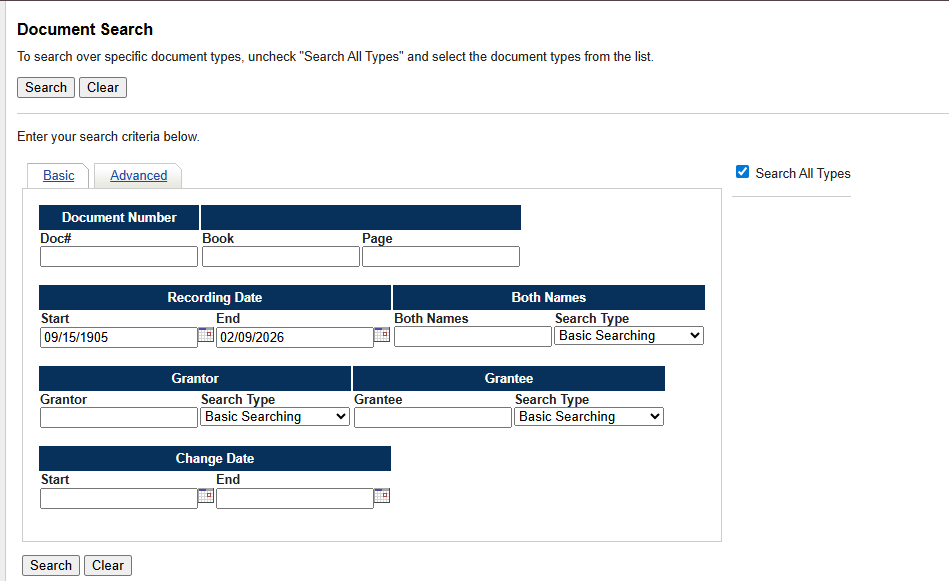
You Will See the “Document Search” Screen
Your screenshot shows the Document Search – Basic Tab.
At the top, you’ll see:
- Search button
- Clear button
- Tabs: Basic | Advanced
- “Search All Types” checkbox (already checked)
Document Number Section
Fields:
- Doc #
- Book
- Page
Recording Date Section
Fields:
- Start Date
- End Date
Default start shows: 09/15/1905
Default end shows: Current date
Both Names Field
Field:
- Both Names
- Search Type dropdown (Basic Searching)
This is the easiest way to search.
Type name like this: Smith John
Grantor Section
Grantor = Person who SOLD or transferred property.
Fields:
- Grantor name
- Search Type
Grantee Section
Grantee = Person who BOUGHT or received property.
Fields:
- Grantee name
- Search Type
Search All Types Checkbox
Checked = searches all document types
Unchecked = allows you to select specific document types
If you uncheck it, you can filter for:
- Deeds
- Mortgages
- Liens
- Satisfactions
- Subdivision Plans
Click Search
After entering name or filters:
Click Search button (top or bottom of page).
Results will display:
- Document Type
- Recording Date
- Instrument Number
- Party Names
Click on a result to:
- View summary
- View image (if available)
- Print unofficial copy
Advanced Search Tab
If you click Advanced, you can:
- Search by legal description
- Parcel details
- Instrument number
- Exact document filters
In-Person Requests
Recorder of Deeds Office
313 W. Market Street, Suite 3302
West Chester, PA 19382
Phone: (610) 344-6330
Office Hours: 8:30 AM – 4:30 PM
Mail Requests for Certified Copies
If you need a certified copy:
Include:
- Full name of parties
- Recording date (approximate)
- Document type
- Check for copy fee
- Self-addressed stamped envelope
Send to:
Recorder of Deeds Office (address above)
Fees & Processing Time
There are costs associated with retrieving court records to cover administrative and maintenance expenses. While viewing a public docket online is often free, obtaining physical copies or certified versions involves a fee schedule set by the county. Standard copies usually cost between $0.25 and $1.00 per page, while certification can add $5.00 to $20.00 to the total. Online downloads are processed immediately upon payment, whereas mail-in requests typically take 5 to 10 business days to fulfill depending on the current backlog of the office.
Types of Courts in Chester County
The Chester County court system is part of Pennsylvania’s unified judicial structure and is organized to handle different categories of legal matters efficiently. Understanding the types of courts in Chester County PA helps residents, researchers, and attorneys determine where cases are filed, heard, and recorded. The system follows a clear court hierarchy so that minor matters are handled in lower courts, while serious civil and criminal cases proceed to higher levels. These tribunal divisions and judicial branches ensure that cases are managed by courts with the appropriate authority and expertise.
Court of Common Pleas
The Court of Common Pleas is the main trial court in Chester County and handles major legal disputes and serious criminal proceedings. It has broad jurisdiction and serves as the central authority for many judicial matters in the county. This court also reviews certain appeals from lower courts, making it a key part of the county’s legal structure. Many public records, depending on the case type, may be available through official court record search tools.
Common case types handled here include:
- Felony criminal cases
- Major civil lawsuits
- Family law matters such as divorce and custody
- Estate and probate proceedings
- Appeals from Magisterial District Courts
Magisterial District Courts
Magisterial District Courts are local courts that handle minor legal matters and are often the first step in the legal process. These courts are designed to provide faster resolutions for smaller cases and preliminary hearings in criminal matters. Because they are located in different districts, they improve accessibility for residents across the county. They also play an important role in the court hierarchy by processing cases before they move to higher courts.
Typical matters handled include:
- Traffic violations and summary offenses
- Small civil claims within monetary limits
- Landlord-tenant disputes
- Preliminary arraignments and hearings in criminal cases
Specialized Divisions
Several specialized divisions operate within the Court of Common Pleas to handle specific areas of law. These divisions help improve efficiency by assigning judges who focus on particular case types. This structure ensures that sensitive matters, such as family or juvenile cases, are handled with appropriate procedures and expertise. Specialized divisions also make it easier for users to identify where certain records or proceedings may be located.
Examples of specialized divisions include:
- Family Court (custody, divorce, child support)
- Juvenile Court (cases involving minors)
- Orphans’ Court (wills, estates, guardianships, trusts)
Chester County Court System Structure and Function
The Chester County Court PA system is part of Pennsylvania’s unified judicial framework and handles civil, criminal, family, and probate matters at the county level. It operates through a defined jurisdiction structure so that cases are directed to the proper court, allowing the legal system to function efficiently. The courts in Chester County work together under established judiciary administration procedures. These procedures help maintain consistent case handling, accurate recordkeeping, and orderly courtroom operations, which supports both the public and legal professionals.
Role of the County Judiciary
The county judiciary is responsible for interpreting and applying the law in cases brought before the court. Judges preside over hearings, review evidence, and issue rulings based on Pennsylvania statutes and legal precedent. Their work maintains fairness and stability in the local legal system and ensures that disputes are resolved through established court procedures.
In Chester County, the judiciary also helps supervise specialized divisions and coordinate with court staff to keep proceedings organized and timely. Judges may oversee criminal trials, civil disputes, family law matters, and appeals from lower courts, depending on their assignments.
Key functions of the county judiciary include:
- Presiding over trials, hearings, and motions
- Issuing orders, judgments, and sentencing decisions
- Interpreting state laws and procedural rules
- Reviewing appeals from lower courts
- Maintaining courtroom procedures and legal standards
Court Administration Responsibilities
Court administration plays a major role in supporting daily operations within the Chester County Court PA system. Administrative offices manage records, schedules, filings, and communication between departments. This coordination helps the court system run smoothly and ensures that filings and hearings follow established timelines.
Administrative staff assist judges, attorneys, and members of the public by handling documents, maintaining case files, and processing requests for copies of records. They also manage jury coordination, courtroom scheduling, and electronic record systems used across the county.
Typical court administration duties include:
- Managing case filings and documentation
- Scheduling hearings and courtroom assignments
- Maintaining public records and archives
- Assisting with jury management and notifications
- Supporting electronic filing and record systems
How Jurisdiction is Determined
Jurisdiction refers to a court’s authority to hear a case, and in Chester County this authority depends on the type of case, the amount in dispute, and sometimes the geographic location. The jurisdiction structure helps direct cases to the appropriate court so that proceedings can begin without delay.
For example, minor offenses and small civil disputes usually begin in Magisterial District Courts, while serious criminal cases and large civil matters are handled in the Court of Common Pleas. Family, juvenile, and probate matters may be assigned to specialized divisions that focus on those areas of law.
Factors that determine jurisdiction often include:
- Type of case (civil, criminal, family, probate)
- Monetary value involved in a dispute
- Severity of charges in criminal matters
- Location where the incident or filing occurred
Court Services in Chester County
Chester County courts provide a range of public services designed to help residents, attorneys, and visitors manage legal matters efficiently. These services include case filing, jury duty management, mediation programs, and online payment systems. Many of these processes are now supported through online tools so users can search, submit, or track information without visiting the courthouse. The official county website is the best starting point for accessing these services: https://www.chesco.org
Filing Services
Filing services allow individuals and legal representatives to submit documents related to civil, criminal, family, and probate cases. In Chester County, many filings can be completed electronically, which reduces processing time and makes it easier to track submissions. Users must ensure documents are correctly formatted and all required information is included before submission. Filing fees may apply depending on the case type. The online filing system also provides confirmation receipts and status updates.
Common filing services include:
- Civil and family court filings
- Motion and petition submissions
- Document uploads for ongoing cases
- Filing status tracking
Jury Services
Jury services help residents respond to jury summons, confirm reporting dates, and learn about the jury process. The county provides clear instructions so jurors understand their responsibilities and scheduling requirements. Online resources explain eligibility, postponements, and reporting procedures. Jurors can also find courthouse locations, parking information, and daily reporting updates. These services are intended to make the jury process straightforward and transparent for all participants.
Jury services typically provide:
- Juror reporting instructions
- Postponement or excusal requests
- Orientation information
- Trial attendance guidelines
Alternative Dispute Resolution
Alternative Dispute Resolution (ADR) programs offer mediation and settlement options that may help parties resolve disputes without a full court trial. These services are commonly used in civil, family, and small-claims matters. ADR can save time and reduce legal costs while still providing a structured and fair process. Trained mediators guide discussions and help parties reach voluntary agreements. Courts may recommend or require mediation in certain case types before proceeding to trial.
ADR services may include:
- Mediation sessions
- Settlement conferences
- Arbitration programs
- Pre-trial resolution options
Self-Help Resources
Self-help resources are available for individuals who do not have legal representation. These materials explain court procedures, filing steps, and legal terminology in clear language. Forms, instructions, and guidance documents are often provided online to help users prepare paperwork correctly. Self-help information is educational and does not replace professional legal advice, but it can make court processes easier to understand.
Self-help resources often provide:
- Downloadable court forms
- Filing instructions
- Legal process guides
- Court contact information
Payment Services
Payment services allow users to pay court fees, fines, and other charges securely. Many courts provide online payment portals where users can search for their case and complete transactions electronically. Payment confirmations are usually issued immediately, helping users maintain accurate records. It is important to enter correct case details to ensure payments are applied properly.
Payment services may include:
- Fine and fee payments
- Case-related cost payments
- Online transaction receipts
- Payment history access
Judicial Process
The judicial process is the series of steps a case follows from filing to final decision. It includes case administration, scheduling, hearings, judgments, and possible appeals within the court system. In Chester County and across Pennsylvania, courts follow a structured legal workflow to keep cases organized and fair. Each stage has defined rules, deadlines, and procedures so parties know what to expect. Court clerks, judges, and administrators work together to move cases through the system efficiently. Knowing these stages helps visitors, litigants, and researchers follow a case with more confidence.
Case Lifecycle
Every case moves through a standard lifecycle, starting with filing and ending with resolution or judgment. Once a complaint, petition, or criminal charge is filed, the court assigns a case number and records it in the system. Case administration staff track deadlines, documents, and filings throughout the process. Parties may exchange evidence, submit motions, and prepare for hearings during this stage. The lifecycle may vary depending on the case type, though the basic structure remains consistent.
Typical stages in a case lifecycle include:
- Filing of complaint or charges
- Case registration and docket entry
- Pre-trial motions and document submissions
- Hearing or trial phase
- Final order or judgment
Scheduling & Hearings
After a case is filed, the court schedules hearings or conferences based on the nature of the matter. Scheduling helps manage courtroom availability and ensures each case receives proper time for review. Notices are sent to all parties so they know the date, time, and location of proceedings. During hearings, judges review evidence, listen to arguments, and make rulings on motions or case issues. Some cases require multiple hearings before reaching a final decision.
Hearing procedures often include:
- Pre-trial conferences
- Status hearings
- Evidentiary hearings
- Trial sessions
Appeals Process
If a party disagrees with a court decision, they may file an appeal within a specific time period. The appeals process allows a higher court to review the record of the case and determine whether legal errors occurred. Appeals focus on legal issues rather than presenting new evidence in most situations. The reviewing court may affirm the decision, modify it, or return the case for further proceedings.
Key steps in an appeal may include:
- Filing a notice of appeal
- Preparing transcripts and records
- Submitting written briefs
- Oral argument before appellate judges
- Final appellate decision
Legal Use and Access Restrictions
Public access rules allow people to view many court records, though the information must be used responsibly and within legal limits. Courts provide records for transparency, yet privacy laws and data protection standards control how that information may be used or shared.
Court records often contain sensitive details, so users should review policies before copying, publishing, or redistributing information. Many jurisdictions follow strict privacy compliance practices to protect personal identifiers, sealed cases, and restricted documents. Respecting these rules helps maintain trust in the judicial system and protects the rights of all parties involved.
Responsible Use
Court information is provided for lawful purposes such as research, case tracking, and general public awareness. Using records responsibly means reviewing documents carefully and respecting privacy limits placed on certain data. Users should avoid sharing confidential details or using records in a misleading context. Proper citation and accurate representation of court information are recommended when publishing or referencing records.
Responsible use generally includes:
- Reading and following public access policies
- Using information for legal or informational purposes
- Respecting sealed or restricted records
- Avoiding publication of sensitive personal data
Misuse Consequences
Misuse of court information can lead to legal or administrative action. Courts may restrict access, block accounts, or take enforcement steps if records are used in a way that violates laws or policies. Unauthorized distribution of protected information may also lead to civil penalties or other legal consequences.
Examples of misuse may include:
- Using records for harassment or intimidation
- Publishing confidential or sealed information
- Altering or misrepresenting court data
- Using data for unlawful commercial purposes
Terms Awareness
Most court websites and record systems publish terms of use that explain acceptable activities and limitations. These terms describe lawful usage, privacy standards, and any restrictions on downloading or reproducing materials. Reading these conditions helps users understand their responsibilities before conducting a search or requesting documents.
Key points commonly covered in terms of use:
- Limits on data reproduction or redistribution
- Privacy and data protection requirements
- Disclaimer of accuracy or completeness
- Conditions for requesting certified copies
Court Records Information
A court records overview explains the documents created and stored during legal proceedings. These records form an official history of filings, hearings, rulings, and case outcomes kept within the court’s legal archives. Courts in Pennsylvania maintain detailed case documentation so judges, attorneys, and the public can review proceedings when permitted by law. Records are organized by case number, party name, or filing date, making it easier to locate information. Many courts now maintain both paper files and digital docket records to improve record management and retrieval. Knowing what these records contain and how they are classified helps users search more efficiently and interpret information correctly.
Types of Court Records
Court systems generate many kinds of records throughout the life of a case. Each document serves a different purpose and becomes part of the official file. Some records are created at the start of a case, while others appear during hearings or after a final decision. These materials are stored in structured filing systems and indexed in docket entries.
Common types of court records include:
- Docket records showing case events and filing history
- Complaints, petitions, and charging documents
- Motions, briefs, and supporting exhibits
- Orders, judgments, and sentencing records
- Transcripts of hearings or trials
Public vs Restricted Records
Many court records are available to the public, though some remain restricted to protect privacy or comply with legal requirements. Courts carefully classify records based on content, case type, and applicable law. Sensitive information such as juvenile matters, adoption records, or sealed cases is often limited to authorized parties.
Public records usually include:
- Civil case filings and judgments
- Criminal case dockets
- Court calendars and hearing schedules
Restricted records may include:
- Juvenile proceedings
- Sealed or expunged cases
- Certain family or probate documents
- Records containing protected personal identifiers
These distinctions help courts balance transparency with privacy. Clear public access rules and data-protection practices help prevent misuse while keeping essential legal information available.
Importance of Court Records
Court records play a key role in maintaining accountability and transparency in the judicial system. They provide proof of filings, rulings, and procedural steps taken during a case. Attorneys rely on these records to prepare arguments, file appeals, and verify case history. Researchers and journalists use them to track legal developments and analyze trends.
Court records are important because they:
- Preserve the official history of legal proceedings
- Support fair review and appeals
- Provide reliable reference for legal professionals
- Promote transparency in judicial decisions
Chester County Court Locations and Facilities
Chester County, Pennsylvania, has multiple court facilities that serve different judicial functions, including the main courthouse complex and several Magisterial District Courts. These locations handle criminal, civil, family, and traffic matters depending on jurisdiction. The court system is organized so residents can access services locally while more complex matters are handled at the county-level courthouse. Understanding where each facility is located helps visitors, litigants, and attorneys reach the correct office and avoid delays in proceedings. Court buildings are designed to support hearings, filings, and administrative operations in a structured judicial environment.
Main Courthouse Complex
The primary judicial facility in Chester County is the Justice Center, which serves as the central location for many court operations, including major criminal and civil proceedings.
Accurate Location:
- Chester County Justice Center
- 201 West Market Street, West Chester, PA 19380, USA
This complex houses courtrooms, clerk offices, and administrative departments that manage case processing and judicial scheduling. Visitors typically go here for higher-level cases, record services, and official filings handled at the county level. The building also supports jury operations and public information services.
Key functions of the main courthouse include:
- Criminal and civil court hearings
- Records and clerk services
- Jury administration
- Judicial chambers and court administration
District Court Locations
In addition to the main courthouse, Chester County operates multiple Magisterial District Courts throughout the region. These courts handle preliminary hearings, minor criminal matters, traffic violations, and small civil cases. Having several district courts allows residents to access basic judicial services closer to their communities.
Typical services provided at district courts include:
- Traffic and summary offense hearings
- Preliminary arraignments and hearings
- Small claims and landlord-tenant matters
- Local filing and payment services
How to Find the Correct Court
Determining the correct court location depends on the type of case and jurisdiction. County-level courts usually handle more complex civil, criminal, and family matters, while district courts manage minor or preliminary proceedings.
To identify the proper court:
- Check the case number or citation for court details
- Review official court notices or summons
- Confirm jurisdiction based on the case type or location
Frequently Asked Questions
Below are expanded answers to common court record questions and other access issues related to Chester County courts. These explanations provide practical details so readers understand how record searches and court procedures usually work.
How to Search Court Records?
Court records are usually searched through official online portals or by visiting the clerk’s office. Most systems allow searches by case number, party name, or filing date, and entering accurate information improves results. Online dockets often display case status, hearing dates, and basic filings, though full documents may not always be available digitally. If a search does not return results, trying a different spelling or search method can help locate the case.
Are All Records Public?
Many court records are public, though some remain restricted to protect privacy and comply with legal requirements. Courts may limit access to juvenile matters, adoption records, sealed cases, and documents containing sensitive personal information. Public records usually include civil filings, criminal dockets, and court calendars that allow the public to follow case activity. These limits help maintain privacy compliance and responsible use of legal information.
Why Is a Case Not Showing?
A case may not appear in search results if it was filed recently and has not yet been entered into the electronic system. Errors in spelling, incomplete names, or searching in the wrong court division can also prevent results from appearing. In some situations, the case may be restricted or sealed, which means it will not appear in public searches. Contacting the clerk’s office can often confirm whether the record exists.
How to Get Certified Copies?
Certified copies are official documents verified by the court and often required for legal or administrative purposes. Requests are typically submitted through the clerk’s office in person or by mail, and some courts provide request forms online. Fees usually apply, and processing times vary depending on the number of pages and the court’s workload. Providing the correct case number helps speed up the process.
How Long Do Records Take to Update?
Court records are updated after filings are reviewed and entered by court staff. Some updates appear the same day, while others may take several days depending on the type of filing and workload. Hearing results, motions, and orders may require additional processing time before appearing in the docket. Checking the system periodically is often necessary to see the most recent changes.
What If Online Search Does Not Work?
If an online search system is unavailable or difficult to use, contacting the clerk’s office is usually the best step. Staff can confirm whether records are available and explain alternative ways to obtain documents. Many courthouses provide public terminals where visitors can search records directly, and phone support may also be available for general questions about record searches.
Are Court Records Free?
Basic docket information is often available without cost, especially through public online systems. Fees may apply for certified copies, printed records, or detailed searches performed by court staff. Payment methods and fee schedules are normally listed on official court websites, and charges vary depending on the type of request.